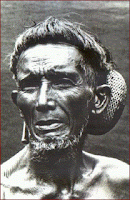
 The Cordillera region of Northern Philippines is the ancestral domain of the Igorots. It is comprised of the six provinces of Abra, Apayao, Benguet, Ifugao, Kalinga, and Mountain Province plus the lone city of Baguio. The Igorots are grouped into six ethno-linguistic groups, the Bontoc, Ibaloi, Ifugao, Isneg (or Apayao), Kalinga, and the Kankana-ey. Below are brief descriptions of these Igorot ethnic groups.
the BONTOC
Alternative/Associated Names: Bontok, Bontoc
LOCATION: Central Mountain Province
DIALECT: Bontok
The Bontocs live in the banks of the Chico River. It used to be a group that was known because of its head-hunting practices. Present day Bontocs are a peaceful agricultural people who have, by choice, retained most of their traditional culture despite frequent contacts with other groups.
The pre-Christian Bontoc belief system centers around a hierarchy of spirits, the highest being a supreme deity called "Lumawig". Lumawig "personifies the forces of nature and is the legendary creator, friend, and teacher of the Bontoc". A hereditary class of priests hold various monthly ceremonies for this deity for their crops, the weather, and for healing. In addition the Bontoc believe in the "anito" -- spirits of the dead who must be consulted before anything important is done. Ancestral anitos are invited to family feasts when a death occurs to ensure the well-being of the deceased's soul.
The Bontoc social structure used to be centered around village wards ("ato"), containing about 14 to 50 homes. Traditionally, young men and women lived in dormitories and ate meals with their families. This gradually changed as with the advent of Christianity. In general, however, it can be said that all Bontocs are very aware of their own way of life and are not overly eager to change.
the IBALOI
Alternative/Associated Names: Ibaloi/Nabaloi
LOCATION: Southern Benguet
DIALECT: Ibaloi
The Ibaloi live mostly in the southern part of Benguet. An agricultural people cultivating rice in terraced fields, they have some affinity in language with Pangasinan, its southern neighbor. Baguio City, the Cordilleras lone city and dubbed as the “Summer Capital of the Philippines” is also situated in Ibaloi country.
The Ibaloi’s major feast is the Pesshet, a public prestige feast of the wealthy, that could last for weeks and involving the butchering and sacrifice of dozens of animals. One of their more popular dances is the Bendiyan Dance that could be participated in by as many as a hundred men and women dancers.
the IFUGAO
Alternative/Associated Names: Ifugao, Amganad, Ayangan, Kiangan, Gilipanes, Quiangan, Tuwali Ifugao, Mayoyao (Mayoyao, Mayaoyaw)
LOCATION: Ifugao Province
DIALECT: Four distinct Ifugao dialects
The country of the Ifugao in the southern part of the Cordillera region is best known for its famous rice terraces, which in modern times have become one of the big tourist attractions of the Philippines. The Ifugaos build their typical houses at the edge of their fields. As distinctive aspect of these house post just below the floor beams to keep rats from climbing into the house.
Aside from their rice terraces, the Ifugaos are known for their literary traditions of the 'hudhud' and the 'alim' . The term "Ifugao" is derived from "ipugo" which means earth people or mortals or humans, as distinguished from spirits and deities. It also means "from the hill", as "pugo" means hill. The Ifugaos’ highest prestige feasts are the "hagabi", for the most wealthy; and the "uyauy", a feast for those immediately below the wealthiest.
the ISNEG
Alternative/Associated Names: Isnag, Dibagat-Kabugao-Isneg, Apayao
LOCATION: Northern Apayao
DIALECT: Isnag
The Isneg (or Apayao) inhabits the banks of the Apayao River and its tributaries in Northern Luzon. Like most erstwhile head-hunters, they are slash-and-burn farmers who have recently, under the influence of their neighbors, begun to practice wet-rice agriculture.
As dry rice farmers, the male head of a household annually clears a fresh section of tropical forest where his wife will plant and harvest their rice. Isneg women also cook the meals, gather wild vegetables, and weave bamboo mats and baskets, while the men cut timber, build houses, and take extended hunting and fishing trips. Often when a wild pig or deer is killed, its meat is skewered on bamboo and distributed to neighbors and relatives. Nearly all Isneg households also harvest a small grove of coffee trees since the main cash crop grown is coffee.
the KALINGA
Alternative/Associated Names: Linimos, Limos; Limos-Liwan Kalinga
LOCATION: Kalinga Province
DIALECT: Kalinga, Limos
Inhabiting the drainage areas of the middle Chico River, the Kalingas are noted for their strong sense of tribal awareness and the peace pacts they have made among themselves. They practice both wet and dry rice farming and they have developed an institution of peace pacts which has minimized traditional warfare and head hunting and serves as a mechanism for the initiation, maintenance, renewal and re-enforcement of kinship and social ties. The Kalinga are divided into Southern and Northern groups; the latter is considered the most heavily ornamented people of the northern Philippines.
The Kalinga society is very kinship oriented and relatives are held responsible for avenging any injury to a member. Disputes are usually settled by the regional leaders, who listen to all sides and then impose fines on the guilty party. These are not formal council meetings but carry a good deal of authority.
the KANKANA-EY
Alternative/Associated Names: Northern Kankana-ey; Sagada/Besao Igorot, Western Bontoc, Applai
LOCATION: Western Mountain Province, Southeastern Ilocos Sur Province, Northern Benguet
DIALECT: Northern Kankana-ey
The Kankana-ey’s domain includes Western Mountain Province, Northern Benguet and Southeastern Ilocos Sur. Like most Igorot ethnic groups, the Kankana-ey built sloping terraces to maximize farm space in the rugged terrain of the Cordilleras. Two famous institutions of the Kankana-ey of Mountain Province are the dap-ay, the men’s dormitory and civic center, and the ebgan, the girl’s dormitory where courtship between young men and women took place.
Kankana-ey’s major dances include takik, a wedding dance and ballangbang.
References
1. "PHILIPPINE ETHNIC MOTIFS Vol. 3" as part of the Okir project by the Product Development and Design Center of the Philippines and the Philippine National Museum)
2. UNREACHED PEOPLES `81 -- David C. Cook Publishing Company
3. Cordillera Philippines
4. BIBAK NE Homepage
Read more...

 There is an Igorot Dance video taken during the 18th anniversary of the Philippine International Bible Church of Montgomery County, in Maryland last month. What's special about the video is that it had my sister and my brother-in-law amongst the dancers. While my brother-in-law is a natural dancer, I haven't seen my sister dance that much. And, this is the second time I saw them dance together (though with other dancers) since they got married more than 8 years ago. Check this video from the Igorot Video Collection website.
 I am slowly transferring all my webpages from the sagada-igorot.com website into this blog. I just copied over 2 articles on Igorot Dances; and I have some left-over pictures. I can't remember where I got these 12-year old photographs. If some kind soul out there can let me know, I'd appreciate it very much.


 Posts
Posts


